On cost
Why Does High-Quality Matcha Cost More?
A price is only meaningful when someone can tell you what is inside it.
It would be convenient for a shop like ours if the expensive tin were always the better one. It is not. Price is set by a seller — by scale, by margin, by packaging, by how much a brand spends to be seen — and none of those things happen in a field. Expensive matcha is not automatically good. Inexpensive matcha is not automatically bad.
What a price can do, when someone is willing to explain it, is point at real differences: how the tea was grown, when it was picked, how it was processed and stored, and where it was bought. That is the only version of a price worth trusting. So the question underneath this article is not whether good matcha should be expensive. It is simpler and more useful than that: what actually creates cost in high-quality Japanese matcha?
The work upstream
Matcha Begins Long Before the Mill
Most green tea is a rolled leaf. Sencha is steamed, then rolled and dried over repeated passes, brewed in water, and the leaf is thrown away. Matcha is a different plan from the moment the field is laid out.
Japan's tea industry and the international technical definition of matcha both describe it by method rather than by tier: leaf grown under shade before harvest, steamed, then dried without rolling to become tencha, sorted with stems and veins removed where appropriate, and finally milled into a fine powder. That last word matters — the powder is not steeped and discarded. It is drunk whole, which leaves nowhere for a defect to hide.
Read down that list slowly and it becomes a list of costs:
- Shading structures or cloth, installed and removed each season.
- A harvest of young, selected leaf rather than a maximised cut.
- A dedicated tencha drying line — not the rolling machinery a sencha factory owns.
- Sorting and de-stemming, which removes weight the producer has already grown.
- Milling, cold storage and packing of a powder that ages quickly once exposed.
Every additional step is labour, infrastructure, time and — most expensively — selection. Selection means deliberately discarding material you were paid nothing to grow.
Shade
Shade, Time and Yield
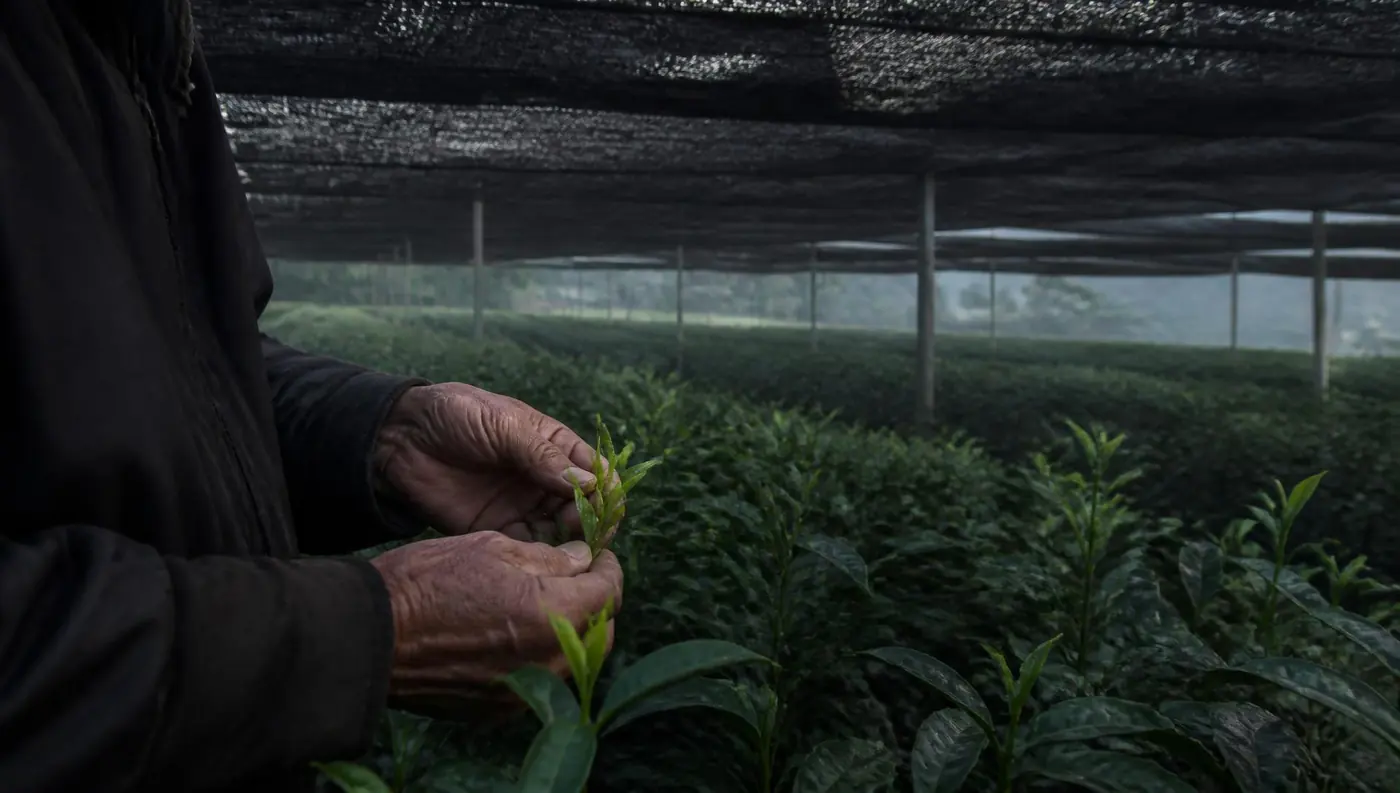
Shading is the defining agricultural act in matcha. In the weeks before harvest the rows are covered, and the plant responds to reduced light by altering its chemistry — retaining more of the amino acids associated with sweetness and umami, moderating the catechins associated with astringency, and deepening the colour of the leaf. It is why a good bowl of matcha tastes savoury rather than merely green.
Shading can reduce yield while increasing labour and infrastructure requirements.
We would like to put a number on that, and we will not. Japanese research from NARO and from prefectural tea stations treats the relationship between covering rate, timing and duration as a genuine trade-off, and publishes practical guidance — recommendations on shade density, on beginning cover at a particular leaf stage, on how long to hold it. What that literature does not give is a single defensible percentage for yield loss, and with the right material and timing some studies report yield holding level or improving. Outcomes vary by cultivar, method, region and shading system. Anyone quoting a tidy figure is usually quoting a blog.
The honest version is this: shade buys quality with light, and light is what a plant turns into weight. The farmer pays for the covering, pays for the labour of putting it up and taking it down, and accepts a crop grown for character rather than volume.
Timing
First Harvest, and What It Does Not Mean
Ichibancha — first harvest, first flush — is the season's first plucking of new spring growth, before the second and third flushes that follow. The chemistry of a shoot changes as the year goes on: first-flush leaf is consistently found to be higher in free amino acids, theanine among them, and lower in catechins than later growth. That is the profile most people are describing when they say a matcha tastes sweet and deep rather than sharp.
It also arrives in a narrow window, once, and the tea year's highest prices are paid at the beginning of it. Scarcity of timing is real scarcity.
And still: first harvest does not automatically mean best. It is not an official grade. It is not a synonym for ceremonial grade — a phrase we examined at length in our piece on what ceremonial grade actually means. Cultivar, shading regime, leaf selection, the skill of the drying line and the care of the milling all still decide what ends up in the bowl. A poorly handled first flush is worse than a well-made second.
Evidence
Some of the Difference Can Actually Be Measured
In 2018 NARO, Japan's national agricultural research organisation, examined the relationship between the price of domestic matcha and its chemical composition. Higher-priced matcha in that work tended to carry more theanine, showed a different relationship between the catechins EGCG and EGC, and presented a greener, chlorophyll-rich colour profile.
We want to be careful with what that means. It is not a finding that price guarantees quality, and it is not a licence for any brand to point at its own price tag as evidence. What it establishes is narrower and more interesting: at least some of the distance between cheaper and more expensive matcha shows up in a laboratory, not only in marketing copy. There is something physically different in the powder.
Which returns us to the same principle. The measurement is of the tea. The price is a claim about the tea. The two only line up when someone can show their work.
After the harvest
Processing, Storage and the Mill
Once picked, tencha leaf is steamed quickly and dried flat. No rolling — that single omission requires an entirely different kind of factory from the one that makes sencha. The dried leaf is then sorted, and stems and veins are separated out where appropriate, because they carry a coarser, more bitter character than the leaf blade. What remains is a fraction of what came off the field.
Milling is the slowest part. Traditional stone grinding is low-throughput by nature and sensitive to heat: turn it faster and friction warms the powder, which costs aroma and colour, and the particle character changes with it. Research into matcha texture treats particle fineness and shape as measurable variables that shape how the tea feels and tastes in the mouth. Patience here is not romance; it is a technical requirement, and it is expensive because time is.
Then there is what happens after. Matcha is a perishable powder with an enormous surface area exposed to air, light and warmth. Cold storage, opaque and airtight packing, and modest pack sizes exist because freshness is a quality of the product, not a courtesy. Any of that can be skipped to save money, and the saving is real — it is simply taken out of the tea.
Structure
A Smaller Tea Industry Meets a Larger World
There is a second reason good matcha costs what it does, and it has nothing to do with any individual farm. Japan's tea sector has been contracting for years. Cultivated area has fallen substantially over the past decade, the number of households whose main work is tea has dropped sharply while the remaining growers have grown older, and processing factories — the tea industry's shared infrastructure — have closed steadily alongside them.
At the same time, tencha is one of the very few parts of Japanese tea that is growing, because demand for powdered green tea outside Japan has risen faster than anyone in the industry planned for. Farms are converting rows to tencha. Converting takes years.
Set those two facts beside each other and the tension is plain: fewer producers, fewer factories and an ageing workforce are being asked to supply a world that has only recently discovered matcha. Cost is what tension looks like on an invoice.
Where things stand
The Current Market, Briefly
One benchmark tells the story efficiently. At the JA Zen-Noh Kyoto tea market in Joyo City on 13 May 2026, the first tencha auction of the season averaged ¥14,127 per kilogram — roughly 71 percent above the 2025 first-auction average of ¥8,235, and the highest level in ten years.
Read it precisely. That is Kyoto, not Japan. It is tencha, the raw material, not finished matcha on a shelf. And it is a first-auction figure, the top of the season's opening day, not an average across the year. It is a signal, not a price list.
Japan's green tea export value also rose steeply between 2023 and 2025, and it is worth separating the parts: value grew considerably faster than volume, which means part of the increase is more tea leaving Japan and part of it is each kilogram costing more. Those are different phenomena and they deserve more room than this article can give them. A dedicated piece on the current market is in preparation.
Place
Where Yame Fits — and Where It Does Not
Yame, in southern Fukuoka Prefecture, has roughly six centuries of documented tea behind it, and Fukuoka remains one of Japan's significant tea-producing prefectures. In MAFF's 2024 crop statistics, Fukuoka ranked sixth nationally in crude-tea production, at 1,650 tonnes. That figure covers crude tea broadly — all of the prefecture's tea, not matcha, and not tencha; no official tencha figure is published for Fukuoka at all. We wrote about the district itself in What Is Yame Matcha?
What distinguishes Yame is a documented culture of codified quality. Its most rigorous publicly recorded standards, and its long record of national competition dominance, are specifically associated with traditional gyokuro — shaded, hand-picked leaf of exceptional care. Japan's Geographical Indication register includes Yame Traditional Hon Gyokuro, a protection that sets out origin and production method in detail.
We should be exact about the limits of that:
- The Geographical Indication applies to gyokuro, not to matcha.
- Yame's competition record, as we were able to document it, is gyokuro-specific.
- We found no authoritative evidence that Yame tencha or matcha generally commands a higher price than equivalent matcha from other regions. Fukuoka's tea market publishes auction prices for new tea broadly, not for tencha as a separate line.
- We found no Yame-specific matcha cooperative standard equivalent to the gyokuro Geographical Indication.
So the honest framing is not that every gram grown in Yame is superior. It is that we buy inside a region whose relationship with shade-grown leaf, with codified quality and with unhurried production is unusually well documented — and that this makes a good starting point, not a finished argument.
Our position
How This Relates to Shishū
Here is what we can tell you about our own tea, stated as plainly as we can manage.
Our matcha is single-origin, from one producer in Yame, Fukuoka. We buy in comparatively small volumes from that producer rather than sourcing blended commodity matcha through the wider market — which costs more per kilogram than blending would, and is the trade we chose.
The two names on our tins are the producer's, not ours. The Matcha Standard and The Finest Matcha are the labels the farm itself uses for its own offerings. The Finest Matcha is the highest grade that producer supplies to us, drawn from the season's first flush. The word “Standard” is worth pausing on: it is the producer's term for its benchmark offering, not an admission of a lesser tea. A house's standard is its statement of what it considers acceptable to sell under its own name.
And what we are not claiming: not that our matcha costs more because Yame commands a documented regional premium — we could not verify that such a premium exists. Not that our producer works to the gyokuro Geographical Indication standard; that standard is for a different tea. What we are claiming is narrower. Shaded leaf, first flush at the top of the range, tencha processing, one farm, small volumes, and a supply chain short enough that we can describe it to you in a paragraph. How we prepare it is set out in The Ritual.
A framework
So What Should a Buyer Actually Look For?
None of this requires our tin. It requires a seller willing to answer questions, and these are the questions worth asking of anyone.
Where was it grown?
A named district — Yame, Uji, Nishio, Kagoshima — is checkable in a way that “product of Japan” is not.
Is the harvest timing known?
First flush, later flush, or unstated. Any answer is more useful than a grade word; “unstated” is itself an answer.
Is it made from tencha?
Powdered green tea is not automatically matcha. Shaded leaf, dried without rolling, then milled — that is the definition worth confirming.
What is known about shading and processing?
A seller close to their source can usually say something specific here. A seller far from it cannot.
Single-origin or blended?
Neither is wrong. Blending is a genuine craft. But you should know which one you are buying.
How fresh is it?
A packing, milling or best-before date, and opaque airtight packaging. Matcha is perishable, and age shows first in the aroma.
How is it intended to be prepared?
Leaf chosen to stand up to milk and sugar is doing different work from leaf chosen for water alone. Both are legitimate; paying for one and receiving the other is not.
Is the explanation specific, or only a label?
The most reliable signal of all. “Premium” and “ceremonial” cost a seller nothing. Facts cost them the effort of knowing their supplier.
In closing
The Most Meaningful Price Is One That Can Be Explained
High-quality matcha costs more because of shade and lost light, because of a harvest window measured in days, because of a factory that dries without rolling and a mill that cannot be hurried, because of cold storage and small packs, and because a shrinking industry is meeting a world that arrived late and hungry. Those are the real reasons, and they exist whether or not anyone is selling you anything.
None of them prove that any particular tin is worth its number — ours included. Price is not proof of quality. It becomes meaningful only when it can be traced back to cultivation, harvest, processing, sourcing and supply.
We would rather tell you where the leaf grew, when it was cut and how it became matcha — and let you decide what that is worth.
The teas themselves are in the shop, described with the same information we have used here.
Questions
Frequently Asked Questions
Why is high-quality matcha expensive?
- Because of how much happens before the powder exists. Matcha begins as tencha: leaf grown under shade, steamed, dried without rolling, sorted, and only then milled. Each of those steps is labour, equipment, time and selection, and shading in particular adds infrastructure while reducing what a field yields. Add a short seasonal window for the best leaf, careful storage of a perishable powder, and a tea industry with fewer farms and fewer factories than a decade ago, and cost accumulates long before anyone prints a label.
Is expensive matcha always better?
- No. Price is set by the seller, not by the leaf. Expensive matcha is not automatically good and inexpensive matcha is not automatically bad. What price can do — when a seller is willing to explain it — is point at real differences in cultivation, harvest, processing and sourcing. A price with no explanation behind it is only a number.
Why does first-harvest matcha cost more?
- First harvest, ichibancha, is the season's first plucking of new spring growth. Research consistently finds first-flush leaf higher in free amino acids such as theanine and lower in catechins than later growth, and it arrives in a narrow window, which is why it generally commands the highest prices of the tea year. It is a statement about timing and chemistry — not an official grade, and not a guarantee that one tea is better than another.
Does Yame matcha cost more than Uji matcha?
- We cannot honestly say that it does. Yame's documented excellence in premium tea is strongest and best evidenced in gyokuro, and we were unable to locate authoritative price data — from MAFF, from Fukuoka Prefecture, or from the Yame tea market itself — showing that Yame tencha or matcha generally sells above equivalent matcha from Uji or elsewhere. Fukuoka's tea auctions publish average and top prices for new tea broadly, not for tencha as a separate category. Anyone claiming a documented regional matcha premium for Yame should be asked to show the data.
What makes matcha different from ordinary green tea?
- Method. Ordinary sencha is rolled during drying and steeped, then the leaf is discarded. Matcha comes from tencha — shaded leaf, dried flat without rolling, with stems and veins removed where appropriate — which is then milled to a fine powder and consumed whole. That is a different crop plan, a different factory, and a different set of costs.
Is ceremonial grade matcha more expensive?
- Usually, yes — but the phrase is retail vocabulary rather than a verified specification. We could not identify an official Japanese grading standard defining it. It often points at genuinely good tea; it does not independently prove quality, and it does not explain a price. We wrote about the term at length in our piece on what ceremonial grade actually means.
Why are matcha prices rising?
- In short: demand for powdered green tea has grown quickly worldwide while Japan's tea-growing base has contracted and aged. The 2026 first tencha auction in Kyoto averaged ¥14,127 per kilogram, roughly 71 percent above the previous year — a single regional benchmark, but a telling one. We are preparing a separate article on the current market, where this deserves proper treatment rather than a paragraph.
Provenance of the facts
Sources & Further Reading
- 国産抹茶の価格と化学成分含有量の関係 (Relationship between price and chemical composition in domestic matcha, 2018)
NARO — National Agriculture and Food Research Organization
- 被覆茶安定生産マニュアル (Manual for stable production of shaded tea, 2018)
NARO — National Agriculture and Food Research Organization
- 直掛け被覆てん茶栽培における一番茶に適した被覆条件 (Shading conditions suited to first-flush tencha under direct covering, 2023)
Kagoshima Prefecture Agricultural Development Center, Tea Division
- 令和7年産一番茶の搸採面積、生葉収穫量及び荒茶生産量 (First-flush picked area, fresh leaf and crude tea production, 2025 crop)
Ministry of Agriculture, Forestry and Fisheries (MAFF), Japan — Crop Statistics
- 作物統計調査 茶の搸採面積・荒茶生産量(主産県別) (Crop statistics: tea area and crude tea production by main producing prefecture, 2024 crop)
e-Stat — Portal Site of Official Statistics of Japan / MAFF
- 地理的表示保護制度 登録第5号:八女伝統本玉露 (Geographical Indication No. 5: Yame Traditional Hon Gyokuro)
Ministry of Agriculture, Forestry and Fisheries (MAFF), Japan
- 宇治茶の抹茶原料「碾茶」初取引 平均落札価格は過去10年で最高値 (First tencha auction, average price a ten-year high; 13 May 2026, Joyo City)
Kyoto Shimbun — JA Zen-Noh Kyoto tea market, Joyo City
- 高単価な茶の輸出拡大と輸入原料の増加 —2025年の緑茶貿易— (Export growth in high-unit-price tea: green tea trade in 2025)
Norinchukin Research Institute, from Ministry of Finance trade statistics
- 緑茶の輸出統計・品目別内訳 (Green tea export statistics, HS 0902.10 / 0902.20 breakdown)
Osaka Customs / Ministry of Finance, Japan
- 粒度と食感からみた抹茶のおいしさ (Palatability of matcha in terms of particle size and texture)
茶業研究報告 Tea Research Journal 128:31–35 (2019)
The tier where those costs are most visible in the cup is The Finest Matcha, offered in a small format as Finest Discovery 10g.