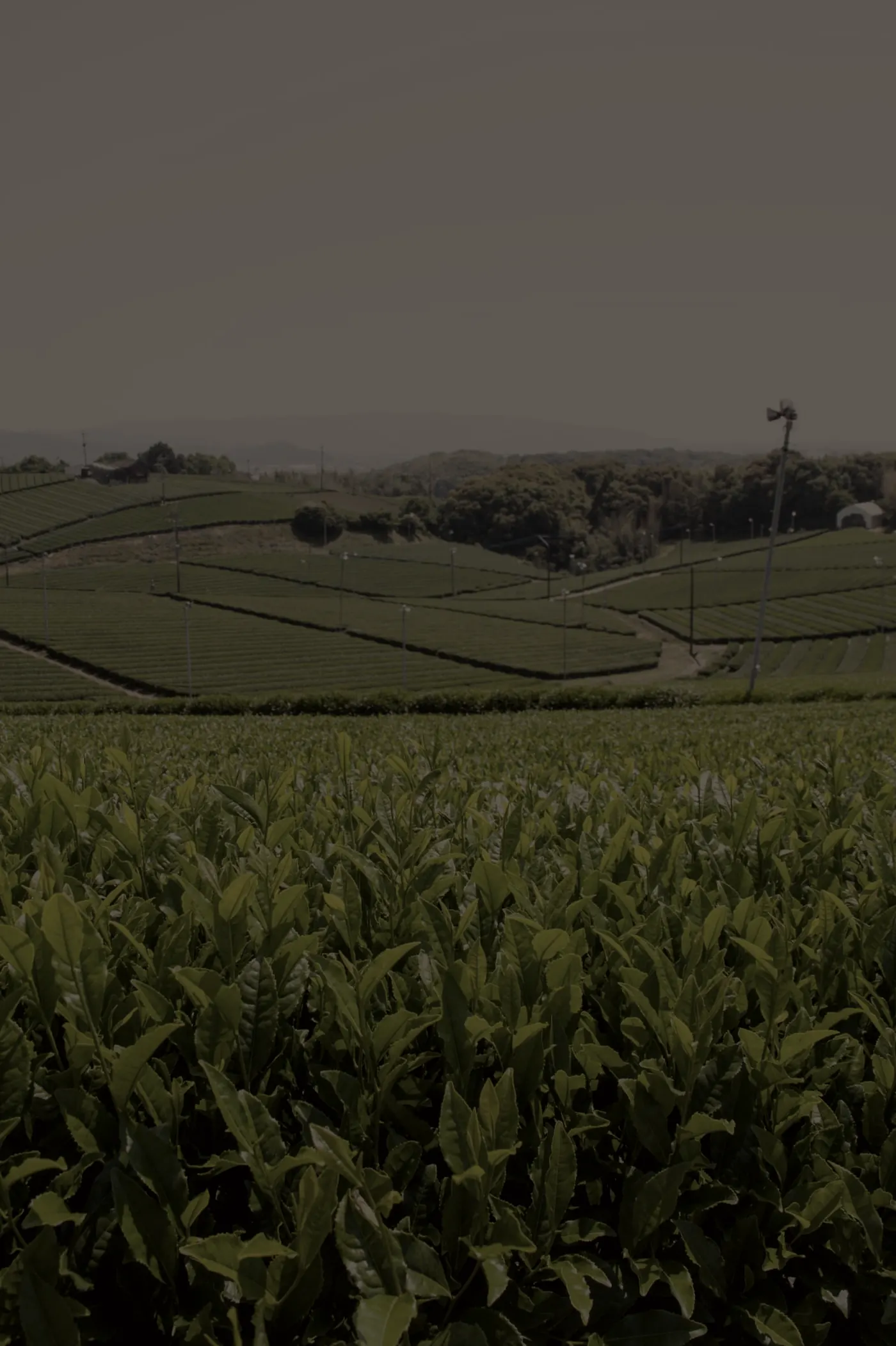
Yame · Fukuoka · Kyushu
What Is Yame Matcha?
A place, first. Everything else follows from it.
Yame matcha is Japanese matcha made from tea grown in the Yame region of Fukuoka Prefecture, on the southern island of Kyushu. The leaf is shaded before plucking, steamed, then dried without rolling — the form called tencha — and milled into a fine, bright powder. The name marks provenance rather than grade. It tells you where the leaf was grown and, by extension, the traditions it was grown under; it does not, on its own, tell you how good it is.
That distinction matters. Single-origin matcha from a named region is a starting point for a conversation about quality, not the conclusion of one. What follows is what can be said about Yame with confidence, and where the honest limits of that knowledge lie.
Six centuries
Yame's Tea Tradition
The traditional account of tea in Yame begins in the early fifteenth century, with a Zen priest named Eirin Shuzui. Returning from Ming China, he is said to have founded Reiganji temple in what is now Kurogi, Yame — the site reminded him of a temple near Suzhou — and to have planted seeds he had brought back, teaching cultivation and processing to the people there. Yame City and Japan's Kyushu Regional Development Bureau both recount this as the origin of Yame tea, and both frame it as a handed-down account rather than an archivally documented event. Six hundred years is a long time for a story to travel intact. What is not in question is the continuity of the craft it describes.
In the modern era, Yame's reputation rests most visibly on gyokuro — shaded leaf tea, the sibling discipline to tencha. Yame gyokuro has taken the top producing-area honour in the gyokuro category of Japan's National Tea Fair for more than two decades consecutively, and Yame Traditional Hon Gyokuro holds a registration under Japan's Geographical Indication protection system, administered by the Ministry of Agriculture, Forestry and Fisheries. Fukuoka tea is a small share of Japan's total volume — the prefecture's planted area is a few percent of the national figure — which tells you something about the region's disposition. It has not competed on quantity.
The ground
Why Yame Is Different
Yame sits at the edge of the Chikugo plain in southern Fukuoka, where flatland gives way to mountains in the east. Fukuoka's own tea industry council identifies Yame as the prefecture's leading tea district by planted area and production, and describes gardens spread across two quite different landscapes: the river-basin fields, and the terraced hillside plots of upland districts such as Hoshino. Elevation, aspect and soil vary considerably between them, which is one reason Yame tea is not a single taste.
The decisive agricultural practice, here as in every matcha region, is shading. Covering the garden in the weeks before plucking alters the chemistry of the new shoot. Studies from NARO, Japan's national agricultural research organisation, show that shading changes the leaf's chlorophyll balance and its levels of catechins and theanine — the amino acid most associated with the savoury depth we call umami. NARO has also found that higher-priced Japanese matcha correlates with higher theanine content and a greener, chlorophyll-rich profile. Shade is not an aesthetic choice. It is the mechanism.
The decisive agricultural practice, here as in every matcha region, is shading. Covering the garden in the weeks before plucking alters the chemistry of the new shoot. Studies from NARO, Japan's national agricultural research organisation, show that shading changes the leaf's chlorophyll balance and its levels of catechins and theanine — the amino acid most associated with the savoury depth we call umami. NARO has also found that higher-priced Japanese matcha correlates with higher theanine content and a greener, chlorophyll-rich profile. Shade is not an aesthetic choice. It is the mechanism.
Without hierarchy
Yame Matcha vs. Other Japanese Matcha Regions
Japan's tea regions are distinct in history and emphasis, not ranked against one another. Uji, in Kyoto Prefecture, is where much of the practice around tencha and matcha was formalised, and it carries that authority still. Shizuoka is the country's largest tea-producing prefecture by volume. Nishio, in Aichi, is widely associated with large-scale tencha and matcha production. Kagoshima, at the southern end of Kyushu, produces at scale with an early harvest calendar. Yame's national distinction is concentrated in shaded leaf, and above all in gyokuro.
Anyone who tells you one prefecture is categorically better than another is selling something. Within every one of these regions there is matcha of great refinement and matcha of no particular interest. The variables that actually decide the cup — cultivar, harvest, shading regime, the care taken in tencha processing, the mill, and how fresh the powder is when it reaches you — sit beneath the level of the region name.
Ichibancha
First Harvest, First Flush
Ichibancha — first tea — is the season's first plucking of new spring growth. In Shizuoka, the prefectural tea council places it between late April and the first days of May; Kyushu's warmer spring generally runs earlier. What follows later in the year is nibancha and beyond.
The reason harvest timing matters is measurable. Research published by Japan's national tea research stations documents how the composition of a tea shoot shifts as it grows: the balance of free amino acids and of catechins is not the same in a young first-flush shoot as in a more mature one later in the season. That balance is what you taste as sweetness and depth against briskness and astringency. It is why first harvest matcha is spoken of the way it is, and why the finest tencha is drawn from it.
The making
From Tencha to Matcha
Matcha is not simply green tea ground up. The path is specific, and each step is a decision.
Shade
The garden is covered in the weeks before plucking, slowing the leaf and altering its chemistry.
Pluck and steam
New leaf is harvested and steamed quickly, arresting oxidation and fixing the colour.
Dry without rolling
This is the step that separates tencha from sencha and gyokuro, which are rolled. Tencha is dried flat and left whole. Stems and veins are then removed, leaving only leaf flesh.
Mill
Tencha becomes matcha only at the mill. Traditional granite stone mills turn slowly by design — the pace keeps heat and friction low, protecting aroma and colour, and yields a particle fineness that suspends in water rather than sinking through it. Stone-ground matcha is slow matcha, in the most literal sense.
Until that final step, what exists is tencha. Matcha powder and matcha tea are the same leaf at two moments in its life.
In the cup
Flavor
High-quality Yame matcha is often described in terms of body: a rounded umami, a natural sweetness that arrives after the first impression rather than with it, low astringency, and a finish that lingers. Well-made shaded leaf tends toward a deep, saturated green in the bowl and a fine, settled foam.
These are tendencies, not guarantees. Flavour is decided by cultivar, by the timing of the harvest, by how long and how densely the garden was shaded, by the skill of the tencha processing, and by the mill. Two matchas from the same district in the same spring can taste meaningfully unlike one another. Anyone describing a whole prefecture's flavour as a fixed profile has stopped tasting and started marketing.
Our position
How Shishū Approaches Yame Matcha
Our matcha comes from Yame, in Fukuoka. That is the whole of the claim, and we prefer it that way. We do not describe our matcha as ceremonial grade: we could not identify an official Japanese national grading standard that defines a category called “ceremonial grade,” so we would rather tell you where the leaf grew and how it was made.
What we hold ourselves to instead is The Matcha Standard — our benchmark for what an everyday matcha from this region ought to be, and the tier we drink ourselves. Above it sits The Finest Matcha, drawn from first-flush leaf and produced in small quantity. You can see both, and the tools that serve them, in the collections.
Roughly two grams
How to Prepare It
Our preparation begins at about two grams — two scoops, sifted fine. Sifting is not fussiness; it is the difference between a smooth bowl and a clumped one, and the care taken there is what you taste later. Water at around 80°C. A steady whisk until the surface turns to velvet, then water to the consistency you want.
Questions
Frequently Asked Questions
What is Yame matcha?
- Yame matcha is Japanese matcha made from tea grown in the Yame region of Fukuoka Prefecture, on the island of Kyushu. Shaded leaf from the district is steamed and dried without rolling to become tencha, and that tencha is then milled into a fine powder. “Yame” describes provenance — the place the leaf was grown — rather than a grade or a flavour standard.
Where is Yame matcha grown?
- In and around the city of Yame in southern Fukuoka Prefecture, Kyushu, together with neighbouring districts of the Chikugo area. Fukuoka's own tea industry council identifies Yame as the prefecture's largest tea-growing area by acreage and production, with gardens ranging from river-basin flatland to terraced hillside plots in the mountainous east.
Is Yame matcha different from Uji matcha?
- They are different places, not different ranks. Uji, in Kyoto Prefecture, is the historic centre where much of Japan's tencha and matcha practice was formalised. Yame is best known nationally for gyokuro — its gyokuro has taken the top regional honour in the gyokuro category of the National Tea Fair for well over two decades running, and “Yame Traditional Hon Gyokuro” is registered under Japan's Geographical Indication system. Both regions produce excellent and unremarkable tea alike; cultivar, harvest, shading and milling matter more than the name of the district.
What does first harvest matcha mean?
- First harvest — ichibancha — is the season's first plucking of new spring growth, before the second (nibancha) and later flushes. Research from Japan's national tea research stations shows that the chemical make-up of a shoot shifts as it grows: young first-flush leaf carries a different balance of amino acids and catechins than later, more mature leaf. In practice, first-flush leaf is generally reserved for the finest matcha.
Is Yame matcha good for lattes?
- Yes, though the choice of tier matters more than the region. A matcha with pronounced umami and a soft finish will carry through milk without turning thin or bitter. We would use The Matcha Standard daily in milk and reserve the smaller, finer tins for water, where nothing is hidden.
How should Yame matcha be stored?
- Matcha is sensitive to air, light, heat, moisture and odour. Keep it sealed and cool, away from spices and strong-smelling foods, and use it within a few weeks of opening. If a tin is kept refrigerated, let it return to room temperature before opening so condensation does not settle on the powder.
Provenance of the facts
Sources & Further Reading
- 八女茶発祥の地「霊巌寺」 / 献茶祭
Yame City, Fukuoka Prefecture
- 八女茶の発祥 (Kyushu cultural exchange story collection)
Kyushu Regional Development Bureau, MLIT
- 地理的表示保護制度 登録第5号:八女伝統本玉露
Ministry of Agriculture, Forestry and Fisheries (MAFF), Japan
- 第79回全国茶品評会 八女玉露が25年連続で日本一
Fukuoka Prefecture Tea Industry Promotion Council
- 被覆茶安定生産マニュアル (Shaded tea production manual)
NARO — National Agriculture and Food Research Organization
- 国産抹茶の価格と化学成分含有量の関係
NARO — National Agriculture and Food Research Organization
- 一番茶・二番茶の摘採時期 (Tea FAQ)
Shizuoka Prefectural Tea Industry Council
If you would like to taste Yame for yourself, The House 40g is the format most people settle into from The Matcha Standard.