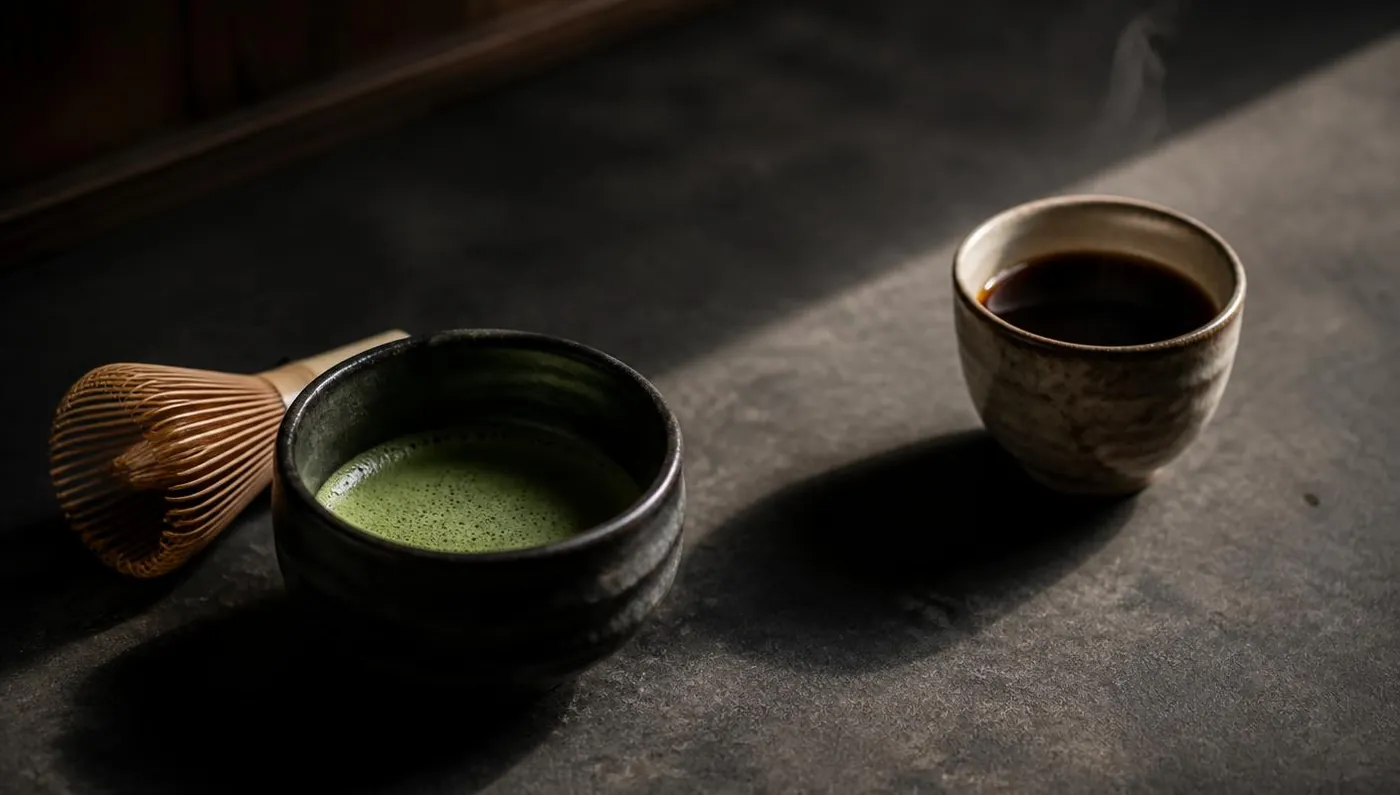
On comparison
Is Matcha Better Than Coffee?
Two rituals, two chemistries, and no predetermined winner.
We sell matcha, so you might expect this article to end one way. It does not. The evidence does not support a verdict, and pretending otherwise would be the kind of claim we have spent the rest of this section arguing against.
Coffee is a serious drink with a serious body of research behind it. Matcha is a serious drink with a much smaller one. Both deserve to be described accurately.
To begin
It Is the Wrong Question — Six Questions Wearing One Coat
“Is matcha better than coffee?” sounds like a single question. It is at least six, and they have different answers:
- Which contains more caffeine?
- Which feels different to drink?
- Which has stronger health evidence?
- Which is better for focus?
- Which is easier to tolerate?
- Which fits the drinker's ritual and taste?
Asked separately, each has a defensible answer — sometimes “coffee”, sometimes “matcha”, and often “nobody has run that study”. Asked together, they produce marketing. What follows separates them.
First, the practical difference
Caffeine, Honestly
Caffeine is the largest practical difference between the two cups, and it is also the one most often stated with false precision on both sides.
Published multi-sample analytical work on matcha reports a wide spread — approximately 18.9–44.4 mg of caffeine per gram of powder. That range is not sloppiness; it is what happens when you measure an agricultural product across cultivars, harvests, shading regimes and grades.
Applied to real servings:
- 2 g of matcha — approximately 38–89 mg across the published analytical range. Roughly 40–70 mg is a practical central planning range sitting inside that wider published range — a convenience for planning a day's caffeine, not a measured value.
- 4 g of matcha — approximately 76–178 mg across the same range, with roughly 80–140 mg a practical central planning range on the same basis.
Those central figures are planning conveniences, not findings. Roughly 40–70 mg is not a measured “premium matcha average”, not a population mean, and not a measurement of our tea. No such published average exists in a form we would stand behind.
Coffee resists a single number just as firmly:
- 8 oz brewed coffee — roughly 80–100 mg in a typical serving.
- 12 oz brewed coffee — roughly 120–200 mg.
- Café servings are frequently larger and can run substantially higher; espresso is highly variable by dose, grind and extraction.
At a glance
Matcha vs Coffee: Caffeine and Composition
| 2 g Matcha — Shishū latte | 4 g Matcha | 8 oz Brewed Coffee | |
|---|---|---|---|
| Caffeine | approx. 38–89 mg | approx. 76–178 mg | approx. 80–100 mg typical |
| L-theanine | naturally present | naturally present | essentially none |
| Major polyphenols | catechins / EGCG | catechins / EGCG | chlorogenic acids |
| Whole leaf consumed | Yes | Yes | No |
| Plain calories | very low | very low | very low |
| Long-term health evidence | limited matcha-specific research | same | extensive observational evidence |
No winners are marked, because the ranges overlap. A strong 2 g matcha can approach a weaker cup of coffee. A 4 g matcha can equal or exceed many brewed coffees. And a large café coffee can exceed both comfortably.
The most important practical variable is usually not which plant you chose. It is how many grams of matcha, or how much coffee, you actually consumed.
Our serving
What 2 Grams Means at Shishū
Shishū uses 2 grams of matcha for a standard latte. That is the serving we build around, and it is deliberately moderate.
Based on published analyses of matcha, 2 g would generally be expected to provide approximately 38–89 mg of caffeine, with roughly 40–70 mg a practical central planning range within that wider published analytical range.
We are being careful with that sentence on purpose. We are not saying “Shishū Matcha contains X mg of caffeine.” Shishū Matcha has not yet been laboratory tested for caffeine. These are research-derived ranges for matcha generally, and cultivar, harvest, shading, growing conditions and product composition all change the actual amount. Only laboratory analysis of our specific tea could establish a product-specific number.
One clarification that saves confusion: milk, oat milk, almond milk, syrup or sweetener changes the nutrition of the finished latte. It does not change how much caffeine was present in the 2 g of matcha you started with.
The popular claim
Does Matcha Really Release Caffeine More Slowly?
This is the most repeated claim in the category, and it deserves a straight answer rather than a dismissal. The usual formulation is that L-theanine makes matcha a “slow-release” source of caffeine, producing a gentler rise and a softer landing.
Reviewing the literature, we could not find support for the mechanism:
- No human pharmacokinetic study comparing plasma caffeine curves from matcha and from coffee.
- No human trial showing that L-theanine delays caffeine's time to peak concentration.
- No evidence that L-theanine extends caffeine's half-life.
What is well established concerns caffeine itself. Caffeine is generally:
- rapidly absorbed;
- nearly completely bioavailable;
- at peak blood concentration roughly 30–60 minutes after consumption in many people;
- cleared with a half-life of roughly 3–7 hours, with considerable individual variation.
We will not overcorrect either. Because no direct head-to-head study exists, we cannot claim that caffeine from matcha is proven to absorb exactly as it does from coffee. The accurate statement is narrower: there is currently no good human evidence that matcha creates “slow-release caffeine.”
Then why the difference
Why Matcha Can Still Feel Different
People are not imagining the difference. They are usually misattributing it. Several plausible contributors, none of which require novel pharmacology:
- A typical 2 g serving often simply contains less caffeine than a full cup of brewed coffee.
- Matcha is frequently consumed more slowly, in a smaller vessel, without a refill.
- Matcha naturally contains L-theanine; coffee essentially does not.
- Individual caffeine sensitivity varies enormously — metabolism differs several-fold between people.
- Ritual, expectation and pace all shape subjective experience.
L-theanine may influence how caffeine feels without necessarily changing how caffeine is absorbed.
That distinction is, we think, the single most useful idea in this article. It allows the common experience to be true without requiring the common explanation to be.
The compound
L-Theanine: What the Research Actually Says
L-theanine is a naturally occurring amino acid found in tea, particularly associated with shaded cultivation. Shading slows the conversion of amino acids in the leaf, and published analyses suggest that highly shaded and first-harvest tea commonly contains more free amino acids and L-theanine than later, unshaded leaf.
Serving estimates, given cautiously because the variation between products is large:
- 2 g of matcha — roughly 15–60 mg of L-theanine, depending heavily on grade and product.
- 4 g of matcha — roughly 30–120 mg on the same basis.
The relationship between shading and amino acids is relevant to The Finest Matcha, which is drawn from the producer's first harvest. It does not permit us to state an L-theanine value for it. We have not tested ours.
Focus
Caffeine Plus L-Theanine and the Question of Attention
There is real controlled human research here, and it is more modest than its reputation. Trials combining isolated caffeine with isolated L-theanine have found modest improvements on some measures — attention-switching accuracy, resistance to distraction, certain task-performance outcomes — often alongside null results on other measures in the same study.
The limitation that matters most is dose. Many of the successful trials used L-theanine at doses approximately equal to or greater than the caffeine dose. A normal 2 g matcha serving may not reliably deliver that ratio: on the ranges above, caffeine frequently exceeds L-theanine in the cup.
So the defensible statement, with its qualification attached:
Matcha naturally combines caffeine and L-theanine, which may produce a different cognitive or subjective experience from coffee.
And the statement we will not make: “matcha gives better focus than coffee.” No direct head-to-head matcha-versus-coffee trial establishes that.
Four claims
Calm Energy, Jitters, Crash, Sustained Energy
These are usually bundled together. They have four different evidentiary statuses.
- “Calm energy” — plausible as a description of experience, but not a precisely defined clinical outcome. Nothing measures it directly.
- Fewer jitters — reasonably plausible, especially because typical matcha servings often contain less caffeine. L-theanine may contribute; the lower dose is likely the larger part of the explanation.
- “No caffeine crash” — unsupported. There is no controlled matcha-versus-coffee study measuring a caffeine crash.
- Sustained 4–6 hour energy — unsupported as a matcha-specific claim. Caffeine's effects last hours regardless of source, because caffeine's own half-life is long.
None of these four will appear as Shishū marketing claims, which is why they appear here instead.
Credit where due
Give Coffee Its Due
Coffee has been studied on a scale matcha has not approached: decades of epidemiological work, cohorts numbering in the hundreds of thousands, hundreds of meta-analyses, and umbrella reviews synthesising those meta-analyses — the BMJ umbrella review of coffee and multiple health outcomes being the standard reference point.
In that body of work, moderate coffee consumption has been associated with lower risk of several outcomes, including all-cause mortality, cardiovascular mortality, type 2 diabetes and several liver outcomes.
The qualification is essential and applies to all of it: much of this is observational evidence, and association does not prove causation. People who drink moderate coffee differ in many ways from people who do not.
Coffee currently has a substantially deeper long-term health evidence base than matcha — largely because coffee has been studied far more extensively.
That is not the same as coffee being healthier. More evidence means more questions asked, not a better answer to any particular one. But we are not going to hide the asymmetry.
Our side of the ledger
What Human Matcha Research Actually Shows
Matcha-specific human research exists. It is thin. Trials tend to be small, short in duration, sometimes industry-linked, and mixed in their results — including at least some studies whose primary outcome was null.
The temptation in our industry is to fill that gap with green-tea studies, or worse, with green-tea-extract studies conducted at concentrations no one drinks. We do not treat those as matcha evidence. A concentrated extract in a capsule is not a bowl of whisked leaf, and a steeped infusion is not one either.
This is the same standard we applied when writing about what “ceremonial grade” does and does not mean. If the specific evidence does not exist, we say so.
A contest worth declining
The Antioxidant Comparison Is Mostly the Wrong Comparison
“Does matcha have more antioxidants than coffee?” is asked constantly and answers almost nothing.
Matcha is rich in catechins, including EGCG. Coffee is rich in chlorogenic acids and other polyphenols. These are chemically different compounds with different absorption, different metabolism and different biological behaviour. Ranking them on one axis requires an axis that does not really exist.
The USDA withdrew its ORAC database precisely because ORAC values were repeatedly misused as proxies for human health effects. Claims of the form “matcha has X times more antioxidants than coffee” usually descend from that withdrawn methodology, and no meaningful human head-to-head trial establishes that either beverage is healthier on account of a higher antioxidant number.
Two different plants need not win the same contest.
A real difference
Whole Leaf Versus Extraction
One genuine structural difference: with matcha, powdered leaf is suspended in water and consumed entirely. With coffee, soluble compounds are extracted and the grounds are discarded. A steeped tea infusion sits closer to coffee in this respect than to matcha.
So matcha generally delivers more of the compounds present in the leaf than an infusion of the same leaf would. That much is straightforward.
What does not follow is that more ingested means more absorbed. Catechin and EGCG bioavailability is low; a substantial proportion of what is swallowed never reaches circulation in the parent form, and plasma concentrations after realistic servings are modest. Whole-leaf consumption is a meaningful difference in what enters the body. It is not, by itself, a health claim.
A persistent myth
Does Matcha Burn Fat?
Short answer: not usefully. Research has found small acute changes in fat oxidation and energy expenditure with green-tea catechin and caffeine combinations, along with a few very small matcha studies pointing the same direction.
But the Cochrane review of green tea for overweight and obesity found any weight-loss effect to be small and not clinically meaningful. Shishū does not claim that matcha burns fat, meaningfully boosts metabolism, or causes weight loss. That is the whole section.
Heart health
Cardiovascular Evidence
Both tea and coffee have research pointing in potentially favourable directions. Coffee's long-term epidemiological evidence is stronger simply by volume; green tea has a respectable cardiovascular literature; matcha-specific outcome research remains limited.
Nothing in that establishes that matcha is better for your heart than coffee, and we will not say it is.
Tolerance
Stomach and Acidity
“Matcha is easier on my stomach than coffee” is a very common report, and for the person reporting it, it is real.
Coffee can stimulate gastric acid secretion. Matcha can also cause nausea in some people, particularly when consumed without food. Gastrointestinal tolerance varies enormously between individuals, and no controlled evidence establishes matcha as universally gentler.
This is an individual-tolerance question rather than a property of either drink, and anything beyond that observation belongs with a clinician rather than a tea company.
Sleep
Caffeine Is Caffeine After Dark
Caffeine can interfere with sleep regardless of whether it came from matcha or coffee. Controlled work has found that substantial caffeine taken even several hours before bedtime measurably disrupts sleep, and caffeine's half-life of roughly 3–7 hours means a mid-afternoon serving can still be present at night.
L-theanine does not cancel that. We would not describe matcha as an evening caffeine option.
Another myth
Neither Drink Dehydrates You
A randomised crossover trial found no evidence of dehydration with moderate daily coffee intake in habitual coffee drinkers. “Coffee dehydrates you, matcha hydrates you” is therefore not a legitimate reason to prefer one over the other. Both contribute fluid.
The honest asterisk
The Latte Problem
Plain matcha and plain black coffee are both very low in calories. Almost nobody is comparing those.
Once milk, oat milk, almond milk, sugar, syrup or cream enters either cup, you are evaluating a recipe rather than a plant. A Shishū latte built on 2 g of matcha can be prepared in a great many ways, some of which are a dessert.
We are not going to call a matcha latte inherently healthier than a coffee beverage. That comparison depends almost entirely on what was added after the matcha.
Behaviour, not chemistry
Ritual May Be the Most Underrated Difference
Behavioural research has found that personally performed rituals can increase enjoyment, perceived flavour and savouring, and can encourage people to slow down before consuming. The effect appears to depend on performing the ritual yourself rather than watching it performed.
We want to be precise about what that means. Whisking matcha does not alter caffeine pharmacology. Nothing about a chasen changes absorption curves. Matcha does not chemically create mindfulness.
The biochemistry is one thing. The behaviour is another. The act of making something deliberately can change the experience of drinking it.
That is the honest case for the bowl, and it is the one we make in the ritual.
So
Which One Should You Drink?
By use case, without badges:
- You want more caffeine — coffee usually provides more per typical serving.
- You want a moderate caffeine serving — a 2 g matcha preparation is often lower.
- You want caffeine naturally alongside L-theanine — matcha.
- You want the strongest long-term health evidence — coffee currently has the deeper research base.
- You want fewer jitters — matcha may be easier for some people, largely because of dose and potentially L-theanine.
- You want better focus — neither has been proven superior head-to-head.
- You want “more antioxidants” — the question is not scientifically useful in that form.
- You care about ritual and preparation — matcha offers a very different experience.
- Taste — entirely personal, and probably the reason most people actually choose.
Matcha and coffee are different beverages with different strengths. Which is “better” depends on what the drinker wants from the cup.
Our two tiers
Where The Matcha Standard and The Finest Matcha Sit
Both of our tiers are producer-defined. The Finest Matcha is drawn from the producer's first harvest and represents the highest tier supplied to us; The Matcha Standard is the everyday benchmark.
Research suggests first-harvest, highly shaded tea commonly contains more free amino acids and L-theanine. That is a general finding about shaded tea. It does not tell us the caffeine concentration of The Finest Matcha, and it does not establish an L-theanine value for either tier.
We are not claiming that one Shishū tier contains more caffeine than the other. Product-specific laboratory testing would be required to say anything of the kind, and the reasons a first-harvest tea costs what it does are a separate subject from what it does in the bloodstream.
A note on method
On Laboratory Testing
Shishū currently uses published analytical research to describe expected ranges rather than pretending a laboratory value exists for our specific tea. Where you see a range in this article, that is why.
If we later commission product-specific laboratory analysis of our matcha, those values can replace the generic research ranges here, and we will say when they were measured.
Everything about where our leaf comes from is in the Yame article.
Questions
Frequently Asked Questions
How much caffeine is in matcha vs coffee?
- Published multi-sample analyses of matcha report roughly 18.9–44.4 mg of caffeine per gram of powder. A 2 g serving therefore falls somewhere around 38–89 mg, and a 4 g serving around 76–178 mg. A typical 8 oz brewed coffee is usually cited at roughly 80–100 mg, and a 12 oz cup at roughly 120–200 mg, with café servings often higher and espresso highly variable. The ranges overlap, so the honest answer is that it depends on how many grams of matcha and how much coffee you actually drink.
How much caffeine is in 2 grams of matcha?
- Based on published analyses of matcha, 2 g would generally be expected to provide approximately 38–89 mg of caffeine, with roughly 40–70 mg a practical central planning range within that wider published analytical range. It is not a measured average, a population mean, or a value measured in our tea. Cultivar, harvest, shading and processing all move the number.
Does matcha have more caffeine than coffee?
- Usually not per typical serving. A 2 g matcha preparation generally sits below a full cup of brewed coffee. A 4 g preparation can match or exceed many brewed coffees. Gram for gram of dry material matcha is caffeine-dense, but people drink far less of it per cup than the coffee they brew.
Does matcha release caffeine more slowly?
- There is currently no good human evidence that it does. We could not find a human pharmacokinetic study comparing plasma caffeine curves from matcha and coffee. Caffeine is generally rapidly absorbed, close to completely bioavailable, peaks in blood roughly 30–60 minutes after consumption in many people, and has a half-life of roughly 3–7 hours with wide individual variation. “Slow-release caffeine” is a popular description, not an established finding.
Does L-theanine slow caffeine absorption?
- No human trial we could find shows L-theanine delaying caffeine's time to peak concentration or extending its half-life. L-theanine may influence how caffeine feels without changing how caffeine is absorbed — that distinction is the honest version of the claim.
Does matcha cause fewer jitters than coffee?
- It is reasonably plausible for many people, but the most likely explanation is dose: a typical 2 g serving often carries less caffeine than a full cup of coffee. L-theanine may contribute. Neither has been demonstrated in a controlled matcha-versus-coffee jitter trial.
Is matcha healthier than coffee?
- Not established. Coffee has a substantially deeper long-term health evidence base — very large observational cohorts and umbrella reviews of meta-analyses — largely because it has been studied far more. Matcha-specific human research is thinner: smaller trials, short durations, some industry-linked work, mixed results. More evidence for coffee does not mean coffee is automatically healthier; it means the questions have been asked more often.
Is matcha better than coffee for focus?
- Unproven. Controlled trials using isolated caffeine plus isolated L-theanine have found modest effects on some attention measures, but many of those trials used L-theanine at doses equal to or greater than the caffeine dose — a ratio a normal 2 g matcha serving may not reliably deliver. No direct head-to-head matcha-versus-coffee trial establishes superior focus.
Is matcha easier on the stomach?
- For some people, apparently. Coffee can stimulate gastric acid secretion, and many drinkers report matcha sits more easily. But matcha also causes nausea in some people, particularly on an empty stomach, and gastrointestinal tolerance varies enormously between individuals. There is no controlled evidence establishing matcha as universally gentler. This is a personal-tolerance question.
How much matcha equals a cup of coffee?
- On the published ranges, roughly 3–4 g of matcha would be expected to land in the same territory as a typical 8 oz brewed coffee, and a 2 g serving usually below it. The overlap is wide enough that no exact equivalence holds across products.
Provenance of the facts
Sources & Further Reading
Each source is labelled with what it actually studied. Matcha, green tea, green-tea extract, isolated caffeine and isolated L-theanine are different evidence categories, and we have not blurred them.
- Determination of caffeine, theanine and catechins across commercial matcha samples — analytical variation between products
Journal of Food Composition and Analysis (peer-reviewed)
Studied: matcha (analytical composition)
- Matcha green tea: chemistry, bioactive compounds and health effects — a review
Molecules (MDPI, peer-reviewed review)
Studied: matcha (composition review)
- Spilling the Beans: How Much Caffeine Is Too Much?
U.S. Food and Drug Administration (FDA)
Reference: caffeine intake guidance
- Scientific Opinion on the safety of caffeine (absorption, half-life, intake levels)
European Food Safety Authority (EFSA)
Reference: caffeine pharmacology and safety
- Caffeine: pharmacokinetics, absorption and metabolism in humans
Pharmacological Reviews (peer-reviewed)
Studied: isolated caffeine (pharmacokinetics)
- Owen et al. (2008) — The combined effects of L-theanine and caffeine on cognitive performance and mood (approx. 50 mg caffeine + 100 mg L-theanine)
Nutritional Neuroscience (randomised, placebo-controlled)
Studied: isolated caffeine + isolated L-theanine, 50 mg / 100 mg
- Haskell et al. (2008) — The effects of L-theanine, caffeine and their combination on cognition and mood (approx. 150 mg caffeine + 250 mg L-theanine)
Biological Psychology (randomised, placebo-controlled)
Studied: isolated caffeine + isolated L-theanine, 150 mg / 250 mg
- Giesbrecht et al. (2010) — L-theanine and caffeine improve task switching but not intersensory attention or subjective alertness (approx. 40 mg caffeine + 97 mg L-theanine)
Appetite (randomised, placebo-controlled)
Studied: isolated caffeine + isolated L-theanine, 40 mg / 97 mg
- Effects of matcha green tea powder on cognitive functions of community-dwelling elderly
Nutrients (randomised controlled trial)
Studied: matcha (human RCT, null primary outcome)
- Coffee consumption and health: umbrella review of meta-analyses of multiple health outcomes
The BMJ
Studied: coffee (observational umbrella review)
- Green tea (Camellia sinensis) for the treatment of overweight and obesity
Cochrane Database of Systematic Reviews
Studied: green tea / green-tea extract (weight outcomes)
- Oral bioavailability of green tea catechins in humans — absorption and plasma concentrations of EGCG
Cancer Epidemiology, Biomarkers & Prevention (peer-reviewed)
Studied: green-tea catechins (bioavailability)
- Withdrawn: Oxygen Radical Absorbance Capacity (ORAC) of Selected Foods, Release 2 (2012)
USDA Agricultural Research Service
Reference: why ORAC “antioxidant scores” were withdrawn
- Caffeine effects on sleep taken 0, 3, or 6 hours before going to bed
Journal of Clinical Sleep Medicine (randomised, double-blind)
Studied: isolated caffeine (sleep)
- No evidence of dehydration with moderate daily coffee intake
PLOS ONE (randomised crossover trial)
Studied: coffee (hydration)
- Rituals enhance consumption
Psychological Science (behavioural experiments)
Studied: ritual behaviour, not any beverage's chemistry
If you are replacing a daily cup rather than an occasional one, The Daily 20g from The Matcha Standard is the everyday format.